How to Reduce Air Fryer Standby Energy & Stop Wasting Power
If you’ve ever noticed your air fryer’s little standby LED still glowing hours after you finished cooking, you’ve probably wondered how to reduce standby energy from an air fryer without constantly trekking to unplug it. Most people don’t realize that even “off” small kitchen appliances sip small amounts of power 24/7, adding up to avoidable waste and small extra utility costs over time.
Per U.S. Department of Energy data, small appliance standby power makes up 5 to 10% of total average household energy use, and air fryers are frequent culprits because of their always-on digital controls. Even models that meet current efficiency standards draw 0.5 to 5 watts while idling, which adds up if you leave yours plugged in year-round.
First, let’s break down exactly why your unit pulls power even when you’re not using it.
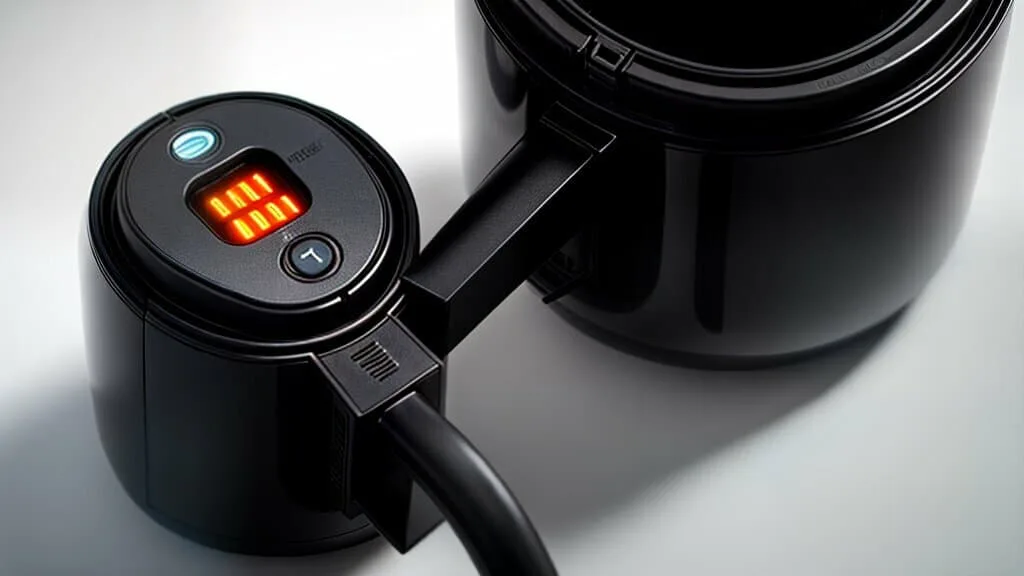
Image source: Web (Bing) / fryerhouse.com (Web image (fair-use with source credit))
Quick Answer
To reduce standby energy from an air fryer, start by checking if your model has a built-in physical power switch. If not, use a smart plug or power strip to cut power completely after each use. Unplugging the unit cuts all idle draw.
Most models draw 0.5 to 5 watts while idling. These steps cut wasted power with minimal hassle.
Why Your Air Fryer Still Draws Power When It’s “Off”
Even when your air fryer’s display is dark and it’s not heating, it’s almost always still pulling a small amount of power from your wall outlet. This is called standby power, phantom energy, or vampire drain, and it’s common for any appliance with digital controls, sensors, or connectivity features.
For air fryers specifically, three components keep the power flowing while “off”:
- The digital control panel that waits for button inputs to start a new cycle
- The small LED standby indicator light that shows the unit is plugged in
- Wi-Fi modules in smart models that stay connected to your home network for app control
Manufacturer specifications confirm most standard air fryers draw 0.5 to 5 watts while idling. Older models from before 2020 often sit at the higher end of that range, while newer units built to meet EU Ecodesign Regulation 2019/2021 standards max out at 0.5 watts standby. This is a tiny amount per hour, but it adds up if the unit stays plugged in 24/7 for months or years.
It’s also totally separate from the 1200 to 1800 watts the unit draws when actively cooking, which only runs for the 15 to 45 minutes most households use the appliance daily. If you’ve noticed uneven cooking from your air fryer, that’s usually a separate issue from standby power draw.
The 3 Quick Checks That Determine Your Best Fix
Your ideal standby power fix depends on three simple checks you can do in 2 minutes, no tools required. These narrow down your options so you don’t waste time on solutions that won’t work for your setup.

Image source: Web (Bing) / storables.com (Web image (fair-use with source credit))
Check 1: Does your air fryer have a built-in physical on/off switch?
If yes: Flip this switch to off after each use. This cuts all power to the unit without unplugging it, and it’s the simplest fix available.
If no: Move to check 2.
Check 2: Is your kitchen outlet easy to reach without moving other appliances?
If yes: Unplugging the air fryer after each use is free and effective, as long as you don’t mind the extra step.
If no: Move to check 3.
Check 3: Do you have a smart plug or power strip nearby that can handle your air fryer’s wattage?
If yes: Plug the air fryer into the smart plug, and set a schedule to cut power 30 minutes after your typical cooking time ends, or use a power strip with a master switch to kill power to multiple small appliances at once.
If no: You may need to move the air fryer to a more accessible outlet, or invest in a low-cost smart plug rated for high-wattage kitchen appliances. If your air fryer’s display flickers even when it’s plugged in and off, that’s a sign of a separate electrical issue related to common display glitches.
Step-by-Step Fixes for Every Air Fryer Setup
Once you’ve run through the 3 quick checks, follow the step-by-step fix that matches your air fryer setup. All fixes take 5 minutes or less to implement.

Image source: Bing (Web (fair-use with source credit))
Fix 1: Use the built-in physical power switch (for units with this feature)
Step 1: Locate the switch, usually on the side or back of the unit near the power cord.
Step 2: Flip it to the “off” position after every cooking session, before you walk away from the counter.
Step 3: Confirm the standby LED light goes dark to make sure power is fully cut.
This fix costs nothing and requires no extra purchases.
Fix 2: Unplug the unit after each use (for easily accessible outlets)
Step 1: Pull the plug straight out of the outlet after cooking, don’t yank the cord.
Step 2: Store the plug out of sight if you want to avoid clutter.
Step 3: Plug it back in 5 minutes before you plan to cook to avoid preheating delays.
This is the lowest-cost option, but it’s only practical if your outlet isn’t blocked by other appliances.
Fix 3: Use a smart plug or power strip (for hard-to-reach outlets)
Step 1: Plug the smart plug into your wall outlet, then plug the air fryer into the smart plug.
Step 2: Download the smart plug app and set a custom schedule to cut power 30 minutes after your typical cooking end time, or use a voice assistant to turn it off with a command.
Step 3: For power strips, flip the master switch after cooking to cut power to the air fryer and other small countertop appliances at once.
Smart plugs cost $10 to $20 upfront, but they work for multiple devices, so they pay for themselves quickly if you have several idle-drawing appliances. If you’ve dealt with food flying into your air fryer’s heating element while cooking, you know how important it is to keep the unit’s components in good shape.
Actual Standby Power Savings (And When It’s Worth the Extra Effort)
Most people ask if cutting standby power is even worth the tiny hassle, so let’s break down the real numbers. Your annual savings depend on three factors: your air fryer’s standby power draw, your local residential electricity rate, and how many hours a day you leave it plugged in.
First, the baseline: the average U.S. residential electricity rate as of 2026 is $0.16 per kilowatt-hour (kWh), while the average UK rate is £0.24 per kWh. An air fryer drawing 3 watts of standby power uses 0.003 kWh per hour, or 0.072 kWh per day if left plugged 24/7.
| Scenario | Annual Standby Power Use | Annual Cost (US) | Annual Cost (UK) |
|---|---|---|---|
| 3W air fryer, plugged 24/7 | 26.28 kWh | $4.20 | £6.31 |
| 3W air fryer, plugged 8 hours/day (only when cooking) | 8.76 kWh | $1.40 | £2.10 |
| 1W newer model, plugged 24/7 | 8.76 kWh | $1.40 | £2.10 |
| 1W newer model, plugged 8 hours/day | 2.92 kWh | $0.47 | £0.70 |
As you can see, savings are small for most households, but they add up if you have multiple idle-drawing small appliances, live in a region with high electricity rates like Hawaii or Germany, or use your air fryer rarely enough that unplugging it after each use is no extra hassle. For most people, the biggest benefit is reducing overall household vampire energy waste, not the direct cost savings. If you’re trying to cut overall kitchen energy use, pairing this fix with proper air circulation practices can reduce cooking time and power use even more.
Common Mistakes That Waste More Energy Than They Save
It’s easy to make small mistakes that either negate your standby savings or create new problems. Avoid these common pitfalls to keep your energy use low without extra hassle.
Mistake 1: Yanking the power cord to unplug the air fryer. This damages the cord’s internal wiring, which can lead to electrical faults or fire risks. Always pull the plug straight out from the outlet, not the cord.
Mistake 2: Using an unrated smart plug with your air fryer. Most air fryers draw 1200 to 1800 watts while cooking, so you need a smart plug rated for at least 10A/120V (North America) or 13A/230V (EU/UK) to avoid overheating. Cheap unrated plugs can melt or cause fires.
Mistake 3: Assuming turning off the digital display cuts power. Most air fryers only turn off the screen when in standby mode, but the internal circuitry still draws power. You need a physical switch, unplugging, or a smart plug to cut power fully.
Mistake 4: Buying a new low-standby air fryer just to cut idle power costs. A new air fryer costs $50 to $200, while the maximum annual standby savings for a single unit is $4 to $5. It will take 10 to 50 years to break even on that purchase, which is not cost-effective.
Mistake 5: Leaving the power strip master switch on 24/7. If you use a power strip for multiple appliances, flip the master switch off when you’re not using any of the connected devices to cut all idle draw at once. If you’ve ever had food spill into your air fryer’s heating element from overfilling the basket, you know that proper usage habits cut down on both messes and unnecessary appliance wear.
Non-Negotiable Safety Rules for Electrical Appliance Fixes
Any time you’re working with wall power and high-wattage kitchen appliances, follow these rules to avoid fire, shock, or appliance damage.
Only use smart plugs and power strips rated for your air fryer’s maximum cooking wattage. Most full-size air fryers draw 1200 to 1800 watts during use, so you need a smart plug rated for at least 10A/120V in North America, or 13A/230V in the EU and UK. Never use cheap unrated plugs with high-wattage cooking devices, as these can overheat and melt.
Look for UL, ETL, CE, or UKCA certification marks on all accessories before buying.
Never yank the power cord to unplug your air fryer. Pulling the cord damages internal wiring over time, which can lead to exposed wires, short circuits, or fire. Always grip the plug head firmly when removing it from the outlet.
If your outlet is hard to reach, a smart plug is a far safer long-term option than frequent cord yanking.
Don’t overload power strips. A single power strip should only carry one high-wattage appliance like an air fryer, plus low-draw devices like phone chargers. Exceeding the strip’s amperage rating causes overheating.
If you notice a burning smell from a power strip, unplug everything immediately and replace it.
Avoid using smart plugs with air fryers that have frayed or damaged power cords. Frayed cords are a leading cause of kitchen appliance fires, per U.S. Fire Administration data.
Replace the air fryer or have the cord repaired by a certified technician before plugging it back in, especially if you’ve had food spills into the heating element in the past that could have damaged internal wiring.
If you notice sparking, flickering, or a burning smell when plugging your air fryer in, stop using it immediately and inspect the outlet. Flickering display issues often point to underlying electrical problems that need fixing before you add smart plugs or power strips, and unresolved electrical faults can also cause food to burn unevenly during cooking.
30-Second Decision Guide: Pick Your Fix Without the Guesswork
Pick your standby power fix in 30 seconds flat with this simple decision tree. No extra tools or research required.
If your air fryer has a built-in physical on/off switch, use that after every cooking session. It’s free, requires no extra purchases, and cuts all idle power immediately.
If your air fryer has no physical switch and your outlet is easy to reach, unplug it after each use. This is the lowest-cost option, and it works for any model.
If your outlet is hard to reach or you have multiple idle-drawing small appliances, get a smart plug or power strip with a master switch. Set a schedule on the smart plug to cut power 30 minutes after your typical cooking end time, or flip the master switch when you’re done cooking to kill power to all connected devices at once. Pairing this with proper air circulation practices can cut even more household vampire energy waste.
If you live in an area with high residential electricity rates, or you’re tracking household energy use for budgeting, prioritize the smart plug option. It automates the process so you don’t have to remember to unplug the unit every time.

Image source: Web (Bing) / sarahscoop.com (Web image (fair-use with source credit))
Frequently Asked Questions
Does unplugging my air fryer damage it over time?
No, unplugging your air fryer after each use does not damage it. Air fryers are designed to be plugged and unplugged regularly. The only risk comes from yanking the cord instead of gripping the plug head, which can wear down internal wiring over time.
Always pull the plug, not the cord, to avoid damage.
How much standby power does an average air fryer use?
Most standard air fryers draw 0.5 to 5 watts while in standby mode. Older pre-2020 models often sit at the higher end of this range, while newer units built to meet EU Ecodesign standards draw as little as 0.5 watts. This equals roughly $1 to $5 in annual electricity costs if left plugged in 24/7, depending on your local rates.
Will a smart plug work with my high-wattage air fryer?
Yes, as long as the smart plug is rated for at least 10A/120V (North America) or 13A/230V (EU/UK). Most full-size air fryers draw 1200 to 1800 watts during cooking, which falls well within the capacity of a properly rated smart plug. Always check the plug’s amperage rating before buying to avoid overheating risks.
Do I need to unplug my air fryer if it has a physical power switch?
No, if your air fryer has a built-in physical on/off switch, flipping it to the “off” position after each use cuts all power to the unit, eliminating standby draw entirely. You only need to unplug the unit if it has no physical switch and you can’t use a smart plug or power strip.
Is cutting standby power from my air fryer worth the effort?
For most households, the direct cost savings are small, around $1 to $5 per year per unit. The bigger benefit is reducing overall household vampire energy waste, which adds up across all your small appliances. If you have multiple idle-drawing devices, or live in a region with high electricity rates, the savings are more noticeable.